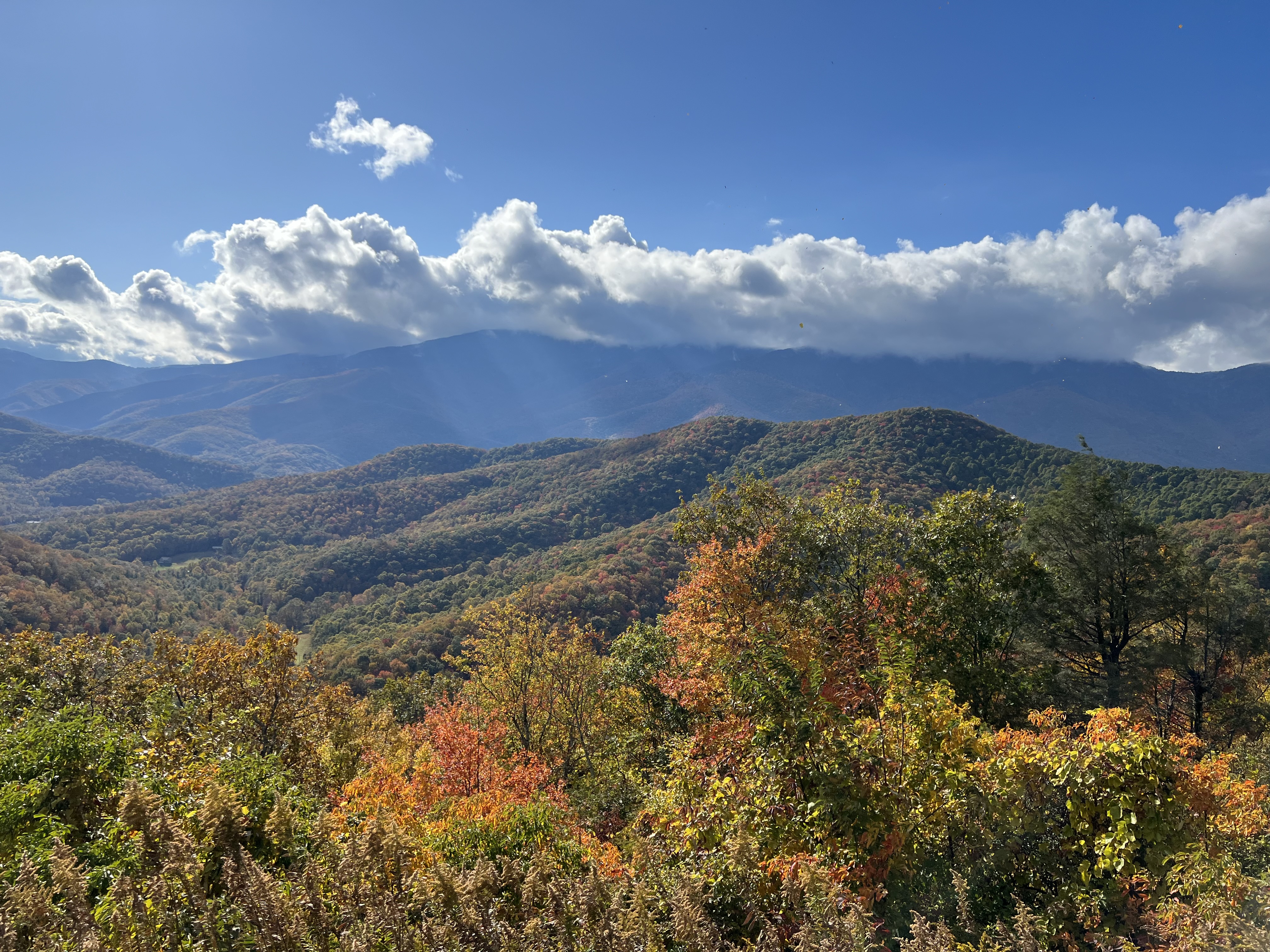
One road, two sons, and a hurricane that did not respect scenic overlooks.
The Blue Ridge Parkway is one of those roads that makes you understand why people give highways nicknames. “America’s Favorite Drive” sounds dramatic until you’re actually on it, winding through the mountains between overlooks, tunnels, ridgelines, and that soft blue haze that gives the Blue Ridge Mountains their name.
For me, the Parkway also has a more personal meaning. It connects Boone, where Noah attends App State, to Asheville, where Jordan attends UNCA. On a map, it is a scenic road through the Carolinas. For me, it’s a mountain thread between two very important people in my life.
The Parkway stretches 469 miles, connecting Shenandoah National Park in Virginia to the Great Smoky Mountains National Park in North Carolina and is designed as a slow, scenic route. Construction began in the 1930s as part of a New Deal-era effort to create jobs, improve access to national parks, and build a scenic motor road through the Appalachian Highlands. The result is not just a drive, but a long, carefully framed view of Southern Appalachia: forests, farms, old cabins, stone walls, overlooks, wildflowers, and mountain communities tucked into the folds of the landscape.
The Boone-to-Asheville stretch is especially meaningful because it passes through some of the most beautiful parts of western North Carolina. It is close to Grandfather Mountain, Linville Falls, Mount Mitchell, Craggy Gardens, and countless overlooks that make you pull over even when you swear you are “just going to keep driving.” Humanity has many weaknesses, and mountain views are one of the better ones.
Then Hurricane Helene hit western North Carolina in September 2024.
The storm caused major damage across the region, including severe impacts to the Blue Ridge Parkway. Recovery work has been happening in phases and is expected to continue through the end of 2026. That damage changed the way the Parkway felt. A road built for beauty and movement suddenly became a reminder of how fragile mountain infrastructure can be. Landslides, washed-out shoulders, fallen trees, damaged overlooks, and closed sections turned a scenic route into a recovery project. It was still beautiful, but it carried a heavier story.
Take your time. The Parkway is not meant to be rushed. Pull over often, bring snacks, wear layers, and let the drive be the point. Oh, and check for road closures before you go.
The Blue Ridge Parkway is more than a scenic road for me. It is the winding mountain line between Boone and Asheville, between Noah and Jordan, and between the places that keep pulling me back to North Carolina.
Camping
Boone KOA is good base for exploring Boone, the northern mountain sections of the Blue Ridge Parkway, and nearby trails and overlooks. I rode out the hurricane here, in my camper. Being a long-time Floridian, my thought was a hurricane in the mountains of NC… cannot possibly be THAT bad. No, it was not as bad as some of the hurricanes I’ve been through in Florida and the Caribbean, but we did have 95mph winds and tons of fallen trees. BIG trees.
Tips

Mount Mitchell (6.684ft) – Highest Peak East of the Mississippi. Just off the Parkway in the Mount Mitchell State Park is an observation deck with spectacular 360 degree views, sometimes as far as 80 miles.


Craggy Gardens is one of the best Parkway stops near Asheville. Only a short hike to beautiful overlooks or a walk through ancient forests right out of a movie.
Leave a Reply